


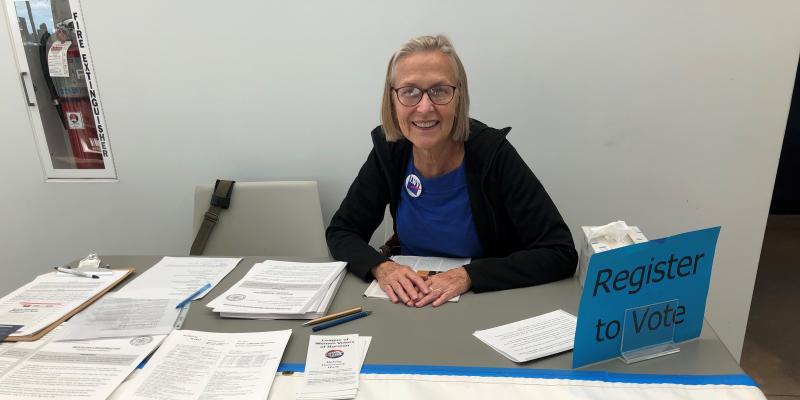

 On-line voter registration is available!
_______________________________________________
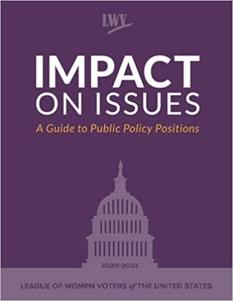
Throughout the years, the League has continued its dual purposes of education and advocacy, engaging in studies on representative government, international relations, natural resources, and social policy. Although our history of advocacy goes back to our beginnings, this version of Impact on Issues covers our advocacy efforts beginning in the 1960s. The publication is available for purchase on Amazon.
Impact on Issues is an indispensable resource for League members. A clear understanding of LWVUS positions, how they interrelate, and how they can complement and reinforce state, local, and regional Inter-League Organization (ILO) positions, strengthens the League’s impact on issues at all levels of government.
==============================================
SUMMARY
The League of Women Voters of Oklahoma (LWVOK) has grown increasingly concerned about suggestions that elections in our state are insecure, if not outright compromised by fraud. Based on a review of the November 2020 general election, we find these suggestions are entirely without foundation or merit—and that, in fact, Oklahoma’s election security protocols and practices appear to be among the safest in the world.
Our investigation into Oklahoma’s election security stemmed from ongoing debate about the security of absentee voting. Driven primarily by the Covid-19 outbreak, demand for mail-in absentee ballots skyrocketed—from 101,253 in the 2016 presidential election, to more than 141,000 in the June 2020 primary, and then to 275,017 in the November general election. This has intensified allegations that mail-in voting opens the door to fraud. Our findings prove this is not true. Creation of restrictions that limit people’s access to their fundamental right to vote are unnecessary. We re-state here our unequivocal opposition to such measures.
After November 2020, election secretaries in 16 of Oklahoma’s 77 counties referred to their local district attorneys a total of 59 potential voting crimes (1). Fifty-three cases involved double voting, in which voters mailed in an absentee ballot and then also voted in person at their polling places. Prosecutors declined to file charges in any of these (2). In fact, only one of the 59 investigations resulted in criminal charges—against a Comanche County woman who completed and submitted her dead father’s absentee ballot (see below).
Voter fraud is, in other words, virtually non-existent in Oklahoma—especially if one considers that single criminal charge in the context of 1,564,886 total ballots cast in November 2020. Measured against 275,017 mail-in votes, county elections officials flagged just two out of every 10,000 ballots cast. As one county election secretary put it, “That’s an ‘A’ on my chart.”
We also agree with the Oklahoma State Election Board’s assessment that our state’s election infrastructure is sound—built to withstand threats ranging from cyberattack to other nefarious schemes such as the stuffing of ballot boxes. Between 2012 and 2020, there were only three other cases of voting crime in Oklahoma—all involving municipal or school board elections, and not races for statewide or national offices (3).
We are alarmed by the irresponsibility of individuals and organizations who continue to insist without evidence that there are “questions and concerns” about election security. Insinuating that there are problems where none exist only serves to undermine public confidence in free and fair elections, which are a cornerstone of the American democracy that LWVOK are pledged to promote and protect.
To read the full written report, please click here.
August 2021 Letter from Paul Ziriax, Secretary of the Oklahoma State Election Board
OCTOBER 2021 LETTER FROM STATE ELECTION BOARD SECRETARY PAUL ZIRIAX
2020 Oklahoma Voting Irregularities by County, 2020 General Election
==============================================